Tuesday, May 3, 2011
Brought to You by the Letter F
Thursday, April 28, 2011
Spring is Sorta' Here + Hard Choices


It appeared as though Spring had officially arrived, then somewhat retreated. 2 weekends ago, I went with the World Vision staff to Terelj National Forest for a retreat weekend. The focus was spiritual development and relaxation. We left Friday and returned on Sunday. We stayed in a hotel that was surrounded by tourist gers. On the way through the park, I noticed small green “pools” on the sides of a few hills. After we arrived, I walked over to one and discovered that it was an artificial turf green for 2 local golf courses, the only 2 in Mongolia. The courses were short (par 3’s were ~100 yards), but they were courses. Unfortunately, it was too early in the season and they were closed. The park is beautiful and we took a short hike up a nearby hill. The park is full of mountains and a winding river, which is surrounded by trees. It is a popular destination, which is reflected in the number of tourist camps (gers, cabins, hotels) along the road. Funny Story: To enter the park costs $.30 for Mongolians and $3 for foreigners (gadaa hoon). I was in a van with 10 World Vision employees and I pulled out my $3 (which is a lot here), but the driver argued on my behalf and I only had to pay $.30! It was nice to spend quality time with my co-workers. Unfortunately, logistics were a challenge and a 4 hour trip turned in 12 hours...including a 3 hour wait at a gas station in the middle of the countryside waiting for a bus to van to pick us up (it never showed and we got into a different car).
Tuesday, April 12, 2011
Vacation and Re-Integration
We are back to Mongolia after a wonderful European vacation. We went to Spain, Portugal, and Morocco on a cruise with our families. The cruise left from Barcelona, went to Casablanca, Agadir, Las Palmas, Funchal, Malaga, and back to Barcelona. We also had a day of rest in Barcelona on either side of the trip. The vacation was much appreciated for multiple reasons, the first of which was seeing our families (siblings included). Next, the warmer climate and exotic food much desired. My favorite destination was Funchal (Madeira) because of the amazing topography of the land, and lushness of the flora in the area. Overall, Funchal is just a beautiful city. One of the things that amazed me was the old districts in the cities. Most of the cities had an area that dated back hundreds (or thousands) of years. These areas were usually full of cafes, narrow cobble-stone streets, and the iconic plants or laundry hanging from balconies. It was great to wander these old streets and see where they took us. It is interesting to compare of the old cities in Europe with our location in Mongolia. Many of the Mongolian “towns” that we have visited are hundreds or thousands of years old too, but the nomadic lifestyle and lack of permanent structures (until the 20th century) has not left the same old districts to wander through. Prior to our trip, we traveled to UB (Ulaanbaatar) for a day of preparation and spending time with friends. Our flight from UB to Moscow was 90 minutes late and we missed the connection to Barcelona, so Aeroflot rerouted us through Paris, then to Barcelona. It was a nice trip, except that our luggage arrived a day late. The next morning, our families arrived and we spent the day seeing the city. Barcelona is very beautiful, particularly the Las Ramblas area, which is a wide pedestrian thorough-fare flanked by shops, restaurants, and hotels. It is a very touristy area, but still fun to visit. We introduced our families to tapas, which had mixed reviews. Our return trip featured a 24 hour layover in the Moscow Airport, terminal D. With only 1 flight to UB each day and no Russian visa, we were stuck in the airport for an entire day. Overall, it wasn’t that bad, but not an enjoyable day. There are no couches or long benches in the airport, only individual seats separated by metal armrests, so we had to contort ourselves into a sleeping position. The food was INCREDIBLY expensive ($10 for a small sandwich, $3 for a very small bottle of water) and there are no drinking fountains. The saving grace was free WIFI and the use of a friends’ computer. Her computer (an Apple) stopped working in Mongolia, but there is no Apple repair store in Mongolia, so I took it with us to Barcelona for repair. It was fixed in Barcelona, so we had a computer to use in the airport. Needless to say, I watched MANY episodes of Colbert Report and the Daily Show.
Transitioning back to Mongolia was not too difficult. We arrived in UB at 7am and nothing opens until 8:30am (including coffee shops), so we sat on the front steps of our favorite breakfast spot until it opened. Then, we dragged our luggage to a guest house and passed out for a long nap. We had spent the previous night on a red-eye flight from Moscow to UB and the previous night to that in the Moscow airport. We needed to sleep. The rest of the day was spent running errands around town and meeting friends. It was very enjoyable. The bus ride home was uneventful, but we returned to apartment problems. While we were gone, a few PCVs lived in our apartment due to the conveniences of water and good windows (sunlight). There was also an English competition, so the countryside PCV teachers crashed at our place for a few nights. It was no problem for us. Unfortunately, the apartment decided to “act up” while we were away. As I had mentioned before, we had a leaky main water valve. About 3 days after we left, the valve burst. The kitchen was flooded, but it was graciously cleaned by a fellow PCV and a Mongolian neighbor. The water company was called and they attempted to fix it. Rather than put a new valve on, they wrapped the entire section of pipe (including the broken valve) with rubber and taped/tied it tightly. This stopped the leaking. However, 3 other leaks sprung-up in the bathroom (water heater joint, toilet, bathtub drain). The water pressure was causing these places in the bathroom to leak. The water company solution was to leave the water running in the sink (all the time, full on). Well, this “solution” lasted until we got home. Upon inspecting the situation and finding the solution unacceptable, the water company was called out the next day and a new valve was purchased for them to install. It was installed and the water is working properly with no leaks. Also, one of the electrical outlets “blew” while we were gone, the main door handle came loose, and the ceiling in the bedroom is becoming dis-attached. The landlady has been called and we have received some of the necessary items, but are still waiting for others.
The week we came back was PC site-visit week. The country director, regional manager, and translator visited each of us at home and tried to meet with our co-workers/boss. My work visit was unsuccessful (World Vision meeting came up). The site-visits are nice and allow for candid conversation about what is going well and what isn’t. Work has been up and down for me. I was informed last week that World Vision has a policy that prohibits non-employees (volunteers) from participating in certain meetings, functions, trainings, etc. I am trying to determine how I can help and be part of the team when I am limited in my abilities. Right now, I am working on advanced trainings regarding smoking and alcohol. The trainings are for health professionals (countryside doctors) and explains the biological mechanisms that occur. Ashley was asked to provide advanced trainings for a new gerentological division (old people) of the ministry of health in UB. Specifically, she was asked to create training regarding osteo-arthritis exercises and targets for older populations. She may go to UB next week to present the material. This weekend I am going to a national forest with members of the WV team for a devotional retreat. The speaker is Mongolian and I’m not sure if any of it will be translated, but I am going for the relationship building aspect and because I will be able to spend some quality time outdoors. I am hoping to go hiking during our free-time.
We are back into the exercise regimen of early March, but with some minor modifications. I met with my taekwondo coach and now he wants to meet with me everyday. My biggest issue is flexibility. I stretch every morning and evening, but it’s still not enough. So, I have started meeting him at 5:30am during the week to stretch and practice taekwondo, then I join the group exercises at 6am (which includes Ashley). The 6am sessions have become popular and there are now about 8 people that participate, including one of my co-workers and one of Ashley’s. It is nice to see community people taking action to improve their health. We have started discussing potential community projects with our coach regarding health in the community. More to follow on this later. Also, my coach is leading a training series and taekwondo competition in a nearby town in June. Coaches from Korea and Russia will attend and he asked me to accompany him. I am planning to go (dates TBD).
The weather has been really nice since we came back. The daytime highs are in the 40s and 50s, with nighttime lows in the teens (sometimes lower). I think the heat to our apartment has been turned off, but it is still very comfortable inside, especially with the south-facing windows. Ashley replanted our herbs/lettuce/spinach because much of it died over the winter. We also purchased a few colorful plants from a local vendor (no idea what they are).
Last night I did the voiceover for a Mongolian commercial. Our local aimag government branch put together a really nice 5 minute tourism video/commercial and they asked me to do the voiceover. Hopefully it will be posted online and I can share a link. Our M20 (previous class) of sitemates are getting ready for their close-of-service conference at the end of April. They will be leaving in June, which is only 6-8 weeks away. Prior to them leaving, the new class of M22 will arrive. We are planning to head to UB to greet them at the airport (similar to what the previous class did for us). It’s scary to think that we will be the “mature” and “knowledgeable” volunteers in this country. It’s almost been a year since we arrived already. Neither Ashley nor I applied to be summer trainers, so we will be staying in our city and working for the most part. We are planning a few outings, maybe a short hiking weekend in May to a neighboring mountain. I’m also planning a rafting weekend with some of the fellow PCVS. More to follow on that later too.
Tuesday, March 8, 2011
Purchasing Differences
Even the common practice of shopping is different in Mongolia. For one, this is an entirely cash based society. Most people have an ATM card, but that is only used to get cash from the bank. There are 2 ATMs for our bank (Khan Bank) in our town, but often one or both of the ATMs are not working or out of cash. Most stores, especially in the countryside, do not take credit cards. However, many of the local stores do give store credit. For example, if I need to purchase food but don’t have cash, the store owner will log the purchases in a notebook and I can pay for them later. I don’t know if there is any interest or what the repayment terms are. Often, the ATM gives out 20,000T bills (about $17). Many of the stores won’t accept 20,000 bills unless your purchases are large. So, it means that we have to “queue up” many small items so that we can break a 20,000T bill. For example, we may wait to buy eggs, milk, bread, peppers, onions, and hyam (sausage for Bear) at once so that we can use a 20,000T.
More interesting are the local purchasing habits. In America, we are used to bulk purchases, the 50 roll toilet paper pack from Costco or 5lbs of cheese from Walmart. Well, here, the exact opposite is done. People typically only buy what they need for that day and will stop by the store everyday. For example, people often buy individual cigarettes or individual feminine products (1 days’ worth). The buyer will tell the clerk what they want and the clerk will remove the number of desired items from open packages from behind the counter. The most extreme case of individual purchasing that I have witnessed is individual pieces of gum. I don't think there is anything that can't be broken down for purchase. Also, if a store or restaurant doesn't have exact change, they will supplement the difference with pieces of gum. It is not uncommon to get a few pieces of gum with your change at a restaurant.
Similarly, purchases are not planned ahead more than 1 day, so there are mad-rushes for items the day before a holiday or major event. For example, yesterday was Women's day and most stores were closed, so there was a rush on alcohol/vodka/cake/flowers the night before. I don't know the rationale for daily purchasing, but it would be an interesting topic for an anthropologist.
Hot Springs Trip
This a picture of the tops of the hot springs huts with the temple in the foreground. The mountains in the distance are in Siberia.
I was excited to be invited along on a trip to Northern Khentii a few weeks ago. We left in utter darkness at 5:40 AM to drive along tire tracks for 5 hours to reach the soum/town of interest. We were greeted warmly at the soum hospital with soup, berries and vodka. The berries were frozen from the summer crop of wild mountain berries. There were three varieties, all of which I’ve never seen before. Thus, I could not provide their English names. After lunch the real adventure began, as we entered complete wilderness, the closest I’ve come to tundra, or maybe that’s what it was. We drive off road, over frozen streams, on steep grades and over bumpy grasslands for six hours. I was truly thankful for the Land Cruiser I was in. We had to disembark once when we slid off an icy overpass and later were briefly stranded on large chunks of ice and water in a stream.
Just before dusk we arrived at a small cabin on a ridge overlooking the flatlands we drove through. This was surrounded by the largest mountains I’ve seen thus far in Mongolia, and Russia, as we were just South of its border. As we arrived there were comments about the 6-7 vehicles already parked. Turns out you don’t make reservations where no cell phones work. It would be a cozy night. We arrived to offerings of milk tea and hard cookies and had a tour of the area. Walking down the ridge brought us to six small wooden huts that sat along the natural hot springs. Each hut had a ‘bathing’ pool to fit 2 people and there was a well to drink the water from. After returning to the cabin a large bottle of vodka emerged. I slipped away to the other side, as this was the fourth offering of the day. Instead I spoke a mix of English and Mongolian and shared dinner and card games with the members of the other room. They happened to be the family of a coworker that was vacationing there. I slept next to ‘Grandma’ that night, toasty warm in my PC issued sleeping bag on the wooden plinth.
The next morning some of the group went to bathe, but I deferred, as it was nude bathing. I did have my swimsuit (on the top of the Land Cruiser), but in a cabin of 25 and the brisk wilderness without an outhouse, I deferred changing. So, I wandered around, enjoyed my first time back in a true forest with tall pine trees and a thick blanket of snow beneath. We left early due to limited sleeping space, driving along the frozen river for the first few hours. We stopped for photos and to collect natural mineral water, formed between two layers of the river’s ice. At three o’clock we stopped at an eight by ten foot cabin set up for cooking along the drive. After a filling lunch of bread, meat, veggies and milk tea, they announced the nine of us were staying there through the night. There was time for another jaunt and there were no wolves to be seen, though my coworkers were sure I’d be eaten. Time for relaxing, singing and more vodka led to an early bedtime followed by a long, extra cozy and uncomfortable night.
The next day we made our way back to the soum, stayed a bit, and eventually drove back to Khentii. We drove in the dark again. This time, there was more indecision regarding which tire treads to follow. At one lonely ger our director departed for 45 minutes when asking for directions. There is the custom of staying for tea and often dinner. This is another opportunity to be present in the moment, not worried by frustrations or delays. Sometimes I think, “what will be, will be,” is an apt phrase for this culture, for better and for worse. We arrived home safe, sleepy and dirty. I look forward to more unexpected adventures.
-written by Ashley
Wednesday, February 23, 2011
Just in case we aren't already strange enough....
Thursday, February 10, 2011
Tsagaan Sar Wrap-Up
Justin, wearing a wolf fur hat (not his), with one of his co-workers.
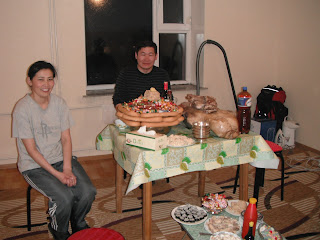
Now that Tsagaan Sar (white month) is over for most people, it is time for a wrap-up of the activities. So, officially, it was scheduled for 2/3-2/5, however, Tsagaan Sar requires a significant amount of prep time for each family. The spring cleaning is done the week before, which requires that everything be washed, including curtains and linens. Also, buuz (steamed meat dumplings) are the traditional food and many families make 500+, which requires that they start the week before. The dumplings are formed and then frozen outside, only to be steamed when ready to eat. Each family cooks a sheep butt/back and makes a pastry tower (boov), which is covered with white foods (dairy, candies).
Here is the routine:
- · Enter the house and exchange official greetings with everyone, starting with elders (the sayings include “are you doing well?” and “have a good new year”)
- · Sit-down at the table and begin eating the white foods
- · Pieces of the sheep are cut-off and passed around for consumption
- · Salads are presented (mayonnaise and cucumber or cucumber and hyam)
- · Drinks (milk tea, fruit juice, vodka, wine, beer) at any onetime, you may have 3-5 drinks in front of you
- · Family photo albums are passed around (especially to show new people)
- · Buuzs are steamed and eaten
- · Refill drinks
- · Exchange gifts (host gives gifts to visitors, visitors give crisp money to host)
- · Leave
- · Host family repeats with the next group of guests
The amount of food and drink is amazing, and not surprisingly, overwhelming. The key to success is moderation at each host, so that you have the ability to eat towards the end of the day.
We visited 5 families (4 co-workers and the kids that we feed). Also, you have to be invited, unless it is a family member. The host family is typically dressed in full traditional attire (deel). The families typically travel to their parents or grandparents hometowns. This results in some families making many cross-country trips and some families are still celebrating (1 week later).
Basically, everything shuts down for a few days, including all stores and supermarkets. So, we had to “stockpile” starting about 1 week beforehand. We were warned that common foods will be sold-out before and after Tsagaan Sar for at least 1 week. This was very good advice because our local food stores are still sold-out of common items (bread, noodles, hyam [not ham, but a salami-like meat product], etc). Also, we had to withdraw a substantial amount of money from the bank because the ATM (there is only 1 in our town) often runs out of money, especially around the holidays.
Overall, we had a really nice time during Tsagaan Sar and we are appreciative of the families that invited us into their homes.
1 Stoplight Province: Big news of the transportation front! Our towns’ first stoplight was installed at the intersection near our apartment. It happened a few months ago, and since we are the only “town” in our province, we live in a 1 stoplight province. Unfortunately, the concept of a stoplight has not been taught to everyone. Daily, drivers ignore the red light and drive through (not even slowing down), which often results in either people jumping out of the way, collisions with other cars, or near misses. Frankly, the stoplight has made my life more dangerous because I never know if a car is going to stop or not…I have to be on my toes and ready to dive. At least with the previous stop signs, everyone seemed to stop.